Most people have an emergency contact.
It may be a spouse, adult child, sibling, close friend, or another person they trust. Their name appears in medical records, employment paperwork, insurance information, and perhaps even on the emergency screen of a phone.
Because that person is listed as the emergency contact, it is easy to assume they will automatically be able to step in and make important decisions if something happens.
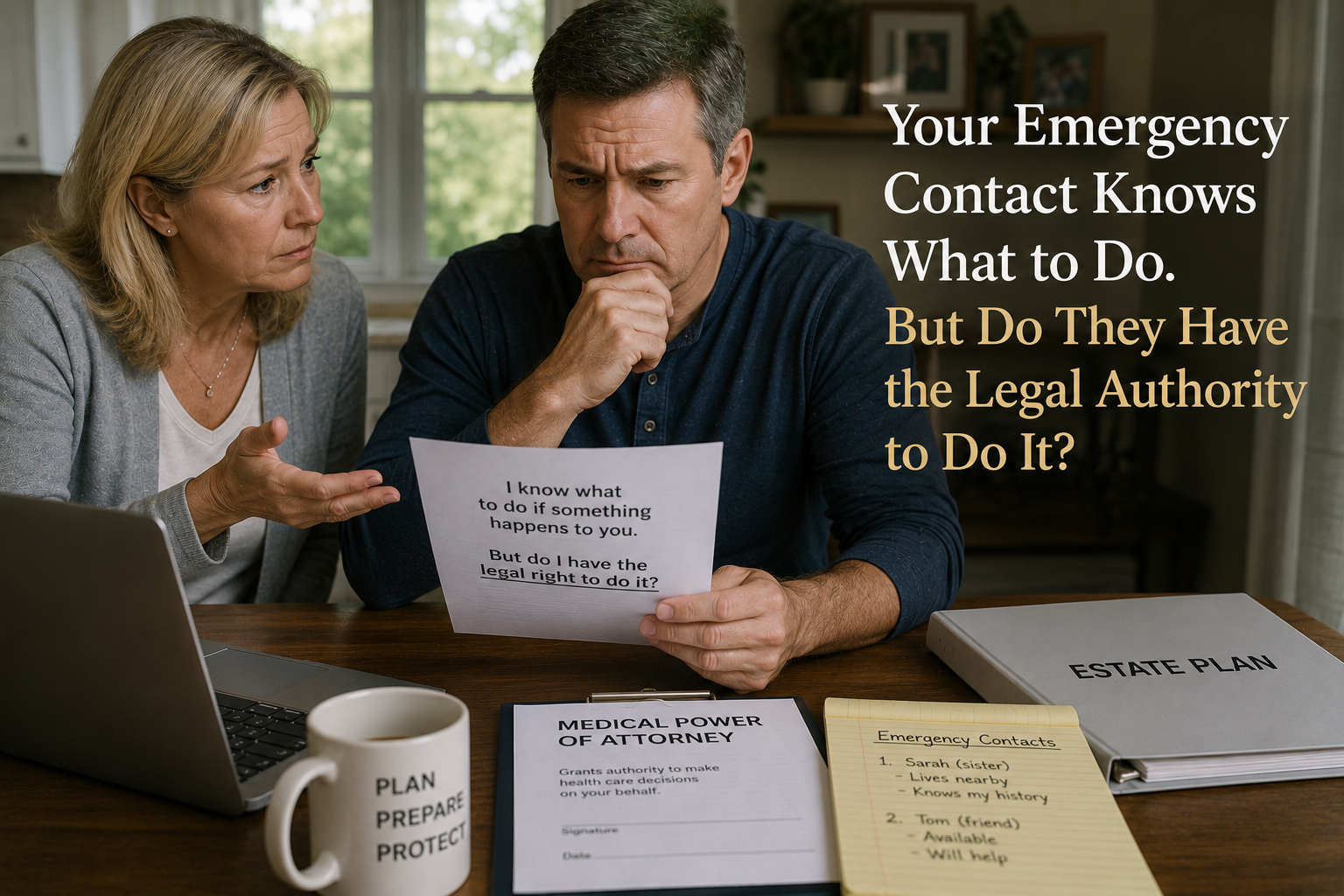
But being someone’s emergency contact and having legal authority to act for them are not necessarily the same thing.
In 2026, as more of our personal and medical information becomes connected through online accounts and electronic records, understanding that distinction is an important part of planning for incapacity.
What Does an Emergency Contact Actually Do?
An emergency contact is generally someone an organization can reach if there is an emergency involving you.
For example, a hospital, employer, school, or other organization might contact that person to:
- Notify them that something happened
- Obtain basic information
- Help locate family members
- Provide updates when appropriate
- Determine whom else should be contacted
Being listed as an emergency contact can be useful, but the designation itself does not necessarily give that individual broad legal authority over your healthcare, finances, or property.
That authority typically comes from other legal documents or applicable law.
Emergency Contact vs. Healthcare Decision-Maker
This distinction becomes especially important during a medical emergency.
You may have listed your daughter as your emergency contact at your doctor’s office. But if you become unable to make your own healthcare decisions, the question is not simply who appears in the “emergency contact” field.
The relevant question becomes who has authority to make healthcare decisions on your behalf under your planning documents and Georgia law.
A properly prepared advance directive for healthcare can allow you to identify the person you want to serve as your healthcare agent if you cannot make certain decisions yourself.
That gives your family something much clearer than an emergency contact entry in a database.
Emergency Contact vs. Financial Power of Attorney
The same issue applies to finances.
Imagine your spouse or adult child is your emergency contact and you unexpectedly become incapacitated.
They may need to address practical matters involving:
- Bills
- Banking
- Insurance
- Property
- Financial accounts
- Other ongoing obligations
Being the person everyone knows to call does not, by itself, necessarily give someone authority to manage those financial matters.
A financial power of attorney can be an important part of establishing who is authorized to act for you under the circumstances described in the document.
Learn more about incapacity and comprehensive planning on our Estate Planning Services page:
“But Everyone Knows They’re the Person I Trust”
This is where informal family expectations can become problematic.
Your spouse may know your wishes. Your oldest child may handle most family matters already. Your sibling may be the person you call whenever something goes wrong.
Everyone may agree about who should step in.
But institutions such as banks, healthcare providers, and other organizations may need appropriate legal authority before allowing someone to make certain decisions or access protected information.
Trust and legal authority serve different purposes.
Your estate plan can help connect the two.
The Right Person Should Be Named in the Right Place
One useful estate planning question is not simply:
“Who is my emergency contact?”
Instead, consider several questions:
- Who should be contacted if something happens?
- Who should make healthcare decisions if I cannot?
- Who should handle financial matters if I become incapacitated?
- Who should administer my estate after my death?
- Who should serve if my first choice is unavailable?
The answer does not have to be the same person for every role.
Someone who is excellent at communicating with doctors may not be the person you want managing complex financial matters. Another person may be well suited to serve as executor but live too far away to be your most practical healthcare agent.
Good planning assigns responsibilities intentionally.
Why Families Often Discover the Difference Too Late
Most people never need to think carefully about the distinction between an emergency contact and a legally authorized decision-maker until something goes wrong.
During an emergency, families may suddenly discover that:
- The person everyone expected to act does not have the necessary documentation
- An old document names someone else
- A former spouse or outdated contact is still listed somewhere
- No successor was named
- Important documents cannot be located
That is a difficult time to begin sorting out authority.
Planning in advance can provide much greater clarity.
Your Phone’s Emergency Contact Is Helpful, But It Isn’t an Estate Plan
Modern smartphones make it possible to store emergency contacts and certain medical information that may be accessible from the lock screen.
That can be extremely useful for helping first responders or healthcare providers identify someone to contact.
But it should not be confused with legal planning.
The same applies to emergency contacts stored with:
- Employers
- Physicians
- Hospitals
- Insurance companies
- Schools
- Online medical portals
These records serve important purposes, but they should work alongside your legal documents rather than replace them.
Review All of Your Decision-Makers Together
One reason inconsistencies develop is that people update information at different times.
You may change your emergency contact with your doctor but forget that your estate planning documents still name someone you selected ten years ago.
Or you may update your power of attorney without updating contact information elsewhere.
A periodic review gives you an opportunity to compare:
- Emergency contacts
- Healthcare agents
- Financial agents
- Executors
- Trustees
- Successor decision-makers
The goal is not necessarily to make every name identical. It is to make sure every choice is intentional and current.
Don’t Forget Your Backup Choices
Your first-choice decision-maker may not always be available.
People move. Relationships change. Health circumstances evolve. Someone who was an ideal choice years ago may no longer be able or willing to serve.
That is why successor appointments matter.
A strong plan considers not only who should act first, but also who should step in if that person cannot.
What Georgia Families Should Review in 2026
If you have not reviewed your incapacity planning recently, consider asking:
- Do I have a current advance directive for healthcare?
- Do I have an appropriate financial power of attorney?
- Are the people named still the people I trust?
- Do they know they have been selected?
- Have I named appropriate backups?
- Can the necessary documents be located during an emergency?
- Do my emergency contact records conflict with my legal documents?
Answering these questions now can prevent uncertainty later.
For more information about estate administration and probate in Georgia, visit our Probate page:
Final Thoughts
An emergency contact is important, but it should not be mistaken for a complete incapacity plan.
The person who receives the phone call may not automatically be the person who has authority to make healthcare decisions, manage finances, or handle other important matters on your behalf.
Estate planning allows you to decide who should have those responsibilities and document your choices before an emergency occurs.
If you are unsure whether the people listed in your emergency contacts and estate planning documents have the authority you intend them to have, Hurban Law can help you review your plan and ensure your wishes are properly documented under Georgia law.