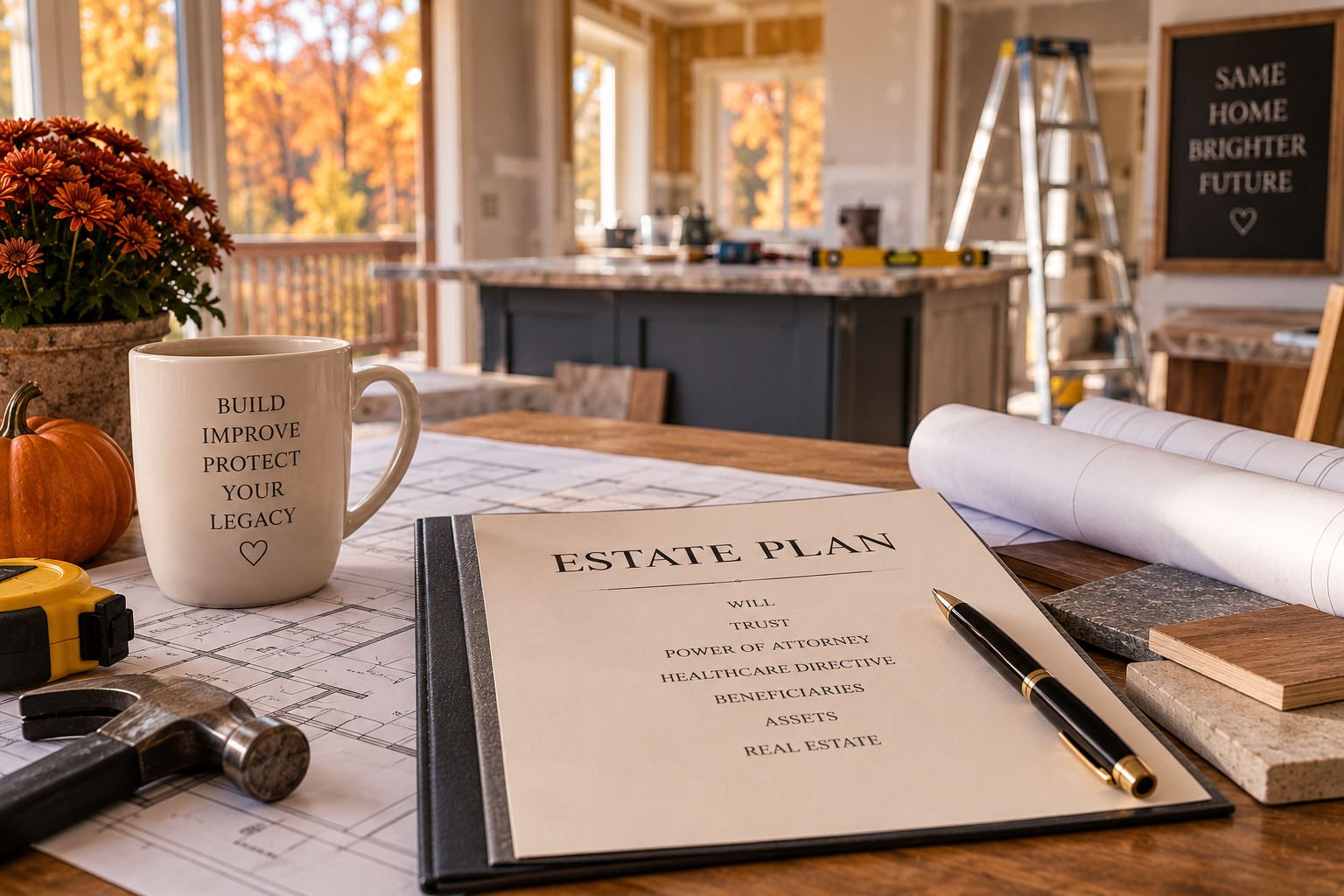
A major home renovation usually starts with practical questions.
How much will it cost? How long will construction take? Which contractor should you hire? Will the project increase the home’s value?
One question probably isn’t on the list:
Does this change anything about my estate plan?
Sometimes, it should.
For Georgia homeowners tackling major projects this fall, a renovation can do more than change the appearance of a home. It can increase equity, create new living arrangements, involve financial contributions from relatives, or turn the house into a much larger part of the owner’s overall estate.
The kitchen backsplash probably doesn’t require a call to your estate planning attorney.
But adding an in-law suite, investing six figures into a remodel, changing ownership to obtain financing, or having an adult child contribute substantially to the property may deserve a closer look.
Here are some of the estate planning questions homeowners should consider after a significant renovation.
1. Has the Renovation Made Your Home One of Your Most Valuable Assets?
Imagine you purchased a Suwanee home years ago for $350,000.
Since then, the property has appreciated, and you decide to invest substantially in:
- A major kitchen renovation
- A finished basement
- An addition
- An outdoor living space
- A second primary suite
- Accessibility improvements
- An accessory living area
After the project, the house represents a much larger portion of your net worth than it did when your estate plan was created.
That matters.
Your will or trust may still say exactly what it said ten years ago, but the economic consequences of those instructions may now be very different.
Suppose your plan leaves the house to one child and divides the remaining assets between two other children.
If the house was worth $300,000 when you created the plan, that distribution may have seemed reasonable.
If the improved property is now worth $750,000 while your other assets have changed little, the eventual inheritance may look very different.
The question isn’t simply whether your home increased in value.
It’s whether your estate plan still produces the result you intended.
2. Who Actually Owns the Home After the Renovation?
A remodel does not ordinarily change property ownership by itself.
But the financial arrangements surrounding a major renovation sometimes do.
Homeowners may refinance, open a home-equity loan or line of credit, change how property is titled, add another person to ownership, or make other financial arrangements to fund the project.
That creates an important estate-planning checkpoint.
How is the property titled now?
Do not assume your will alone determines what happens to a home after death.
How real estate is legally owned can affect how it transfers.
Georgia recognizes different forms of concurrent ownership, and survivorship rights can matter significantly when one owner dies. Georgia law specifically addresses joint interests with survivorship in O.C.G.A. § 44-6-190.
If the ownership structure changed during a renovation or refinancing, the estate plan should be reviewed alongside the deed.
3. What if an Adult Child Paid for Part of the Renovation?
This can become complicated quickly.
Suppose your adult daughter moves into your home and contributes $80,000 toward finishing the basement into a separate living area.
What exactly was that $80,000?
Was it:
- A gift?
- A loan?
- Payment for an ownership interest?
- An informal contribution in exchange for living there?
- An advance against a future inheritance?
Everyone may understand the arrangement today.
Years later, memories can be different.
Now imagine you die and your will divides the estate equally among three children.
The daughter who contributed $80,000 may believe she should be reimbursed before the property is divided.
Her siblings may believe the money was simply her contribution toward years of housing.
That is the kind of disagreement that can be much easier to prevent than resolve.
When a relative contributes substantial money toward property they do not own, consider documenting what the contribution actually means.
4. What Happens When a Family Member Moves Into the Renovated Space?
One increasingly common reason for remodeling is to accommodate another generation.
A homeowner may add or renovate space for:
- An aging parent
- An adult child
- A sibling
- A grandchild
- Another relative who needs assistance
That arrangement can work extremely well during the homeowner’s lifetime.
But the estate plan needs to answer what happens afterward.
For example, suppose your son lives in the renovated basement apartment.
Your will leaves the house equally to all three children.
After your death, does your son have to move out?
Can he continue living there?
Can his siblings force a sale?
Should he have an opportunity to purchase their interests?
Should the property instead be held in trust for a period of time?
These are not merely real estate questions.
They are estate-planning questions created by the way the family actually uses the property.
5. What if You Built an In-Law Suite for an Aging Parent?
Now reverse the situation.
Instead of an adult child moving in, perhaps you renovate part of your home so an aging parent can live with you.
That may raise different planning considerations.
The parent might contribute money toward construction.
They may sell their own house and provide funds to help with the new living arrangement.
Or you may pay for the renovation entirely while becoming increasingly responsible for the parent’s care.
If substantial money changes hands, the family should understand what those funds represent.
Clear records become particularly important when other siblings are involved.
For example, one sibling may later view a parent’s $100,000 contribution toward an addition as money that should somehow be reflected in the parent’s eventual estate.
Another may see it as payment toward housing and care.
Documenting the arrangement while everyone understands it can reduce confusion later.
6. Does a Major Renovation Affect a Home Held in a Trust?
Potentially.
If your home is already part of a revocable living trust, the renovation itself generally does not mean you need an entirely new trust.
But major changes to the property’s value or use can still justify reviewing the plan.
Ask:
- Is the property actually titled to the trust as intended?
- Does the trust still contain appropriate instructions for the home?
- Has the property’s value changed enough to alter the balance among beneficiaries?
- Is someone now living in the property whom the trust does not address?
- Do you want the house sold or retained after your death?
- Who will be responsible for expenses if the property remains in trust?
This is particularly important when a homeowner says:
“I want my children to keep the house.”
That statement raises several additional questions.
For how long?
Who pays taxes and insurance?
Can one child live there?
What if another child wants their share in cash?
Can the trustee sell the property if maintaining it becomes impractical?
A trust can provide structure, but only if its terms reflect what you actually want.
Learn more about trusts and other planning strategies through Hurban Law’s Estate Planning services.
7. A More Valuable Home Can Make an “Equal” Estate Plan Unequal
This issue is easy to overlook.
Suppose your estate plan says:
- Daughter receives the house
- Son receives your investment account
- Remaining property is divided equally
When you signed the documents, both the house and investment account were worth roughly $400,000.
Ten years later, you renovate the house substantially and it appreciates to $800,000.
The investment account is worth $450,000.
Your documents haven’t changed.
But economically, your plan has.
That may be exactly what you want.
If it isn’t, you should know about the imbalance while you can still decide whether to address it.
Estate planning reviews should therefore consider current values and proportions, not merely whether the names in the documents are still correct.
8. What Happens if Your Heirs Cannot Agree About the Renovated Home?
Real estate can be emotionally difficult to divide.
A renovated family home can be even more complicated because different relatives may attach different meanings to it.
One child may see:
“Dad’s house.”
Another may see:
“$700,000 of equity that should be sold and divided.”
A third may see:
“The home I helped renovate and where I’ve lived for eight years.”
Those positions can conflict.
If several people eventually inherit interests in the same property, disagreements may arise over:
- Whether to sell
- Whether someone can continue living there
- Who pays ongoing expenses
- Repairs and maintenance
- Rental arrangements
- Buyouts
- Property improvements
A thoughtful estate plan can anticipate some of those questions rather than leaving the beneficiaries to negotiate everything after death.
9. What About a Mortgage or Home-Equity Loan?
A renovation may increase the value of your home while also increasing your debt.
That distinction matters.
If you borrow $150,000 for a major remodel, your beneficiaries are not simply inheriting the newly improved property’s gross value.
The estate plan should be considered in light of the owner’s complete financial picture, including debts and obligations.
This is particularly relevant if you intend one beneficiary to receive the house.
Would that person realistically be able to maintain the property?
Could they afford:
- Mortgage payments
- Property taxes
- Insurance
- Utilities
- Maintenance
- Remaining renovation debt?
Leaving someone a valuable home is not always the same thing as leaving them an asset they can comfortably keep.
10. Keep Records of Major Improvements
Good renovation records have value beyond remembering which contractor installed the roof.
Keep documentation for significant improvements, including:
- Contracts
- Invoices
- Receipts
- Permits
- Architectural plans
- Proof of payment
- Loan documents
- Records showing family contributions
Tax basis can become relevant when inherited property is eventually sold. Under federal tax law, the basis of inherited property is generally tied to its fair market value at the date of death, subject to applicable rules and exceptions. The IRS discusses inherited-property basis in Publication 551.
Good records can also help a future executor, trustee, or family member understand what was done to the property and how it was financed.
IRS Publication 551: Basis of Assets
11. Renovating for Aging in Place? Review Incapacity Planning Too
Some Georgia homeowners remodel specifically because they intend to stay in their homes as they age.
Projects might include:
- First-floor bedrooms
- Walk-in showers
- Wider doorways
- Ramps
- Improved lighting
- Accessible kitchens
- Additional space for a caregiver
If your renovation is part of an aging-in-place strategy, your estate planning review should not stop with the house.
Consider who could manage financial and property matters if you became incapacitated.
Would someone have authority to:
- Pay the mortgage?
- Handle homeowners insurance?
- Hire contractors for necessary repairs?
- Manage utilities?
- Deal with property taxes?
- Arrange household services?
A financial power of attorney may be an important part of that planning.
Georgia has statutory provisions governing powers of attorney under the Georgia Uniform Power of Attorney Act.
The broader point is simple:
If you’re spending significant money to make your home work for the next stage of your life, make sure your legal planning works for that stage too.
12. What if You Recently Paid Off the Mortgage?
Some renovations happen shortly after homeowners finally pay off their mortgage.
That creates another useful estate-planning checkpoint.
Your home may now represent a substantial debt-free asset.
If it has also appreciated considerably, it may be one of the largest assets your beneficiaries eventually receive.
Review:
- How the property is titled
- Who should receive it
- Whether you want it sold
- Whether one beneficiary should have an opportunity to keep it
- Whether the distribution remains fair alongside your other assets
Paying off the mortgage does not itself change your will or trust.
But it can significantly change your net worth and the role the property plays in your estate.
13. Don’t Add Someone to the Deed Just Because They Helped Pay for the Remodel
Families sometimes look for simple solutions to complicated ownership questions.
An adult child contributes to the renovation, so a parent considers adding the child to the deed.
That can have consequences beyond recognizing the child’s contribution.
Changing a deed can affect ownership rights, creditor exposure, future control of the property, inheritance planning, and potentially tax considerations.
It can also produce results the homeowner did not anticipate if the relationship changes.
Do not treat adding someone to a deed as informal bookkeeping.
Before changing ownership, understand what legal rights the new deed would create and how those rights interact with your estate plan.
14. Your Home Insurance and Estate Plan Solve Different Problems
A major renovation should also prompt an insurance review.
Homeowners may need to make sure coverage reflects the improved property and any changes in how the home is used.
But insurance and estate planning answer different questions.
Insurance asks:
What happens if the property is damaged or destroyed?
Estate planning asks:
What happens to the property if I die or become unable to manage it?
Both matter.
Updating one does not automatically update the other.
When Does a Renovation Actually Justify an Estate Plan Review?
Replacing carpet probably doesn’t.
Neither does repainting the living room.
A review becomes more worthwhile when the project changes something meaningful about your financial or family situation.
Consider reviewing your estate plan if the renovation:
- Significantly increases the home’s value
- Requires substantial new borrowing
- Involves changing the deed
- Is funded partly by a family member
- Creates living space for an adult child or parent
- Makes the property a much larger percentage of your estate
- Changes your plans for who should receive the house
- Is part of an aging-in-place strategy
- Creates a property you hope your family will retain after your death
The relevant issue is not the construction itself.
It is what changed because of it.
A Fall Home Renovation Estate Planning Checklist
If you’ve completed or are planning a significant Georgia home project this fall, ask:
- Who legally owns the property today?
- Did refinancing or financing change anything about the title?
- Is the home held in my trust if it is supposed to be?
- Has the renovation substantially increased its value?
- Does one beneficiary receive the home under my current plan?
- Does that distribution still make financial sense?
- Did a child, parent, partner, or other relative contribute money?
- Is that contribution documented?
- Is someone going to live in the renovated space long-term?
- What happens to that person’s housing after I die?
- Do I want the property sold or kept?
- What happens if my beneficiaries disagree?
- Can the person inheriting the home realistically afford to maintain it?
- Have I kept records of major improvements?
- Does my financial power of attorney provide appropriate authority if I become incapacitated?
A few minutes spent answering those questions can reveal whether the renovation has created estate-planning issues worth addressing.
Frequently Asked Questions
Do I need to update my will after renovating my house?
Not automatically. A renovation does not ordinarily require a new will simply because construction occurred. However, a major increase in property value, a new family living arrangement, changed ownership, or different intentions for the property may justify reviewing your estate plan.
Does remodeling a house change who owns it?
The physical renovation itself generally does not change title. However, refinancing or intentionally changing a deed in connection with the project can affect ownership. Review the current deed rather than relying on assumptions.
What if my child paid for renovations to my house?
Clarify and document what the contribution represents. It could be intended as a gift, loan, housing arrangement, ownership contribution, or something else. Leaving the arrangement informal can create disagreement later.
Should I add my adult child to my deed if they helped renovate the house?
Do not make that decision solely because the child contributed money. Adding someone to a deed creates legal ownership consequences and should be evaluated alongside estate-planning, financial, and tax considerations.
Can I leave my house to one child and other assets to another?
Estate planning can be structured in different ways, subject to applicable law and your circumstances. If you are using different assets to provide for different beneficiaries, periodically review their values because appreciation can change the economic balance of the plan.
What happens if several children inherit the same house?
Co-ownership can require decisions about occupancy, expenses, maintenance, sale, and potential buyouts. If you expect several beneficiaries to receive the property, consider whether your estate plan should provide clearer instructions.
Should my house be in a trust?
That depends on your goals, ownership structure, family circumstances, and broader estate plan. A trust can be useful in some situations, but it is not automatically necessary simply because a home is valuable or recently renovated.
A Renovation Changes the House. Sometimes It Changes the Plan Too.
Most home improvements have nothing to do with estate planning.
But major renovations can create consequences that reach far beyond construction.
A house can become more valuable.
A parent can move in.
An adult child can contribute money.
A basement can become someone’s permanent home.
A mortgage can disappear or a new loan can take its place.
An asset that once represented a modest part of your estate can become its centerpiece.
Your estate planning documents may remain exactly the same through all of it.
That is why the right question after a significant renovation isn’t necessarily:
“Do I need a new will?”
It is:
“Does my existing plan still make sense now that the property has changed?”
Final Thoughts
Fall home projects are often about making a house fit the next stage of life.
Your estate plan should fit that stage too.
For Georgia homeowners, a significant renovation can be a useful reason to review how the property is owned, who should ultimately receive it, whether family financial contributions are properly documented, and what should happen if several beneficiaries have different plans for the home.
You do not necessarily need to rewrite an estate plan every time you improve your property.
But when the renovation changes the home’s value, ownership, financing, or role within your family, ignoring the estate-planning side can leave important questions unanswered.
If you’ve made major changes to your home or are unsure whether your current will or trust still handles the property the way you intend, Hurban Law can help you review your plan under Georgia law.
Learn more through Hurban Law’s Estate Planning services.